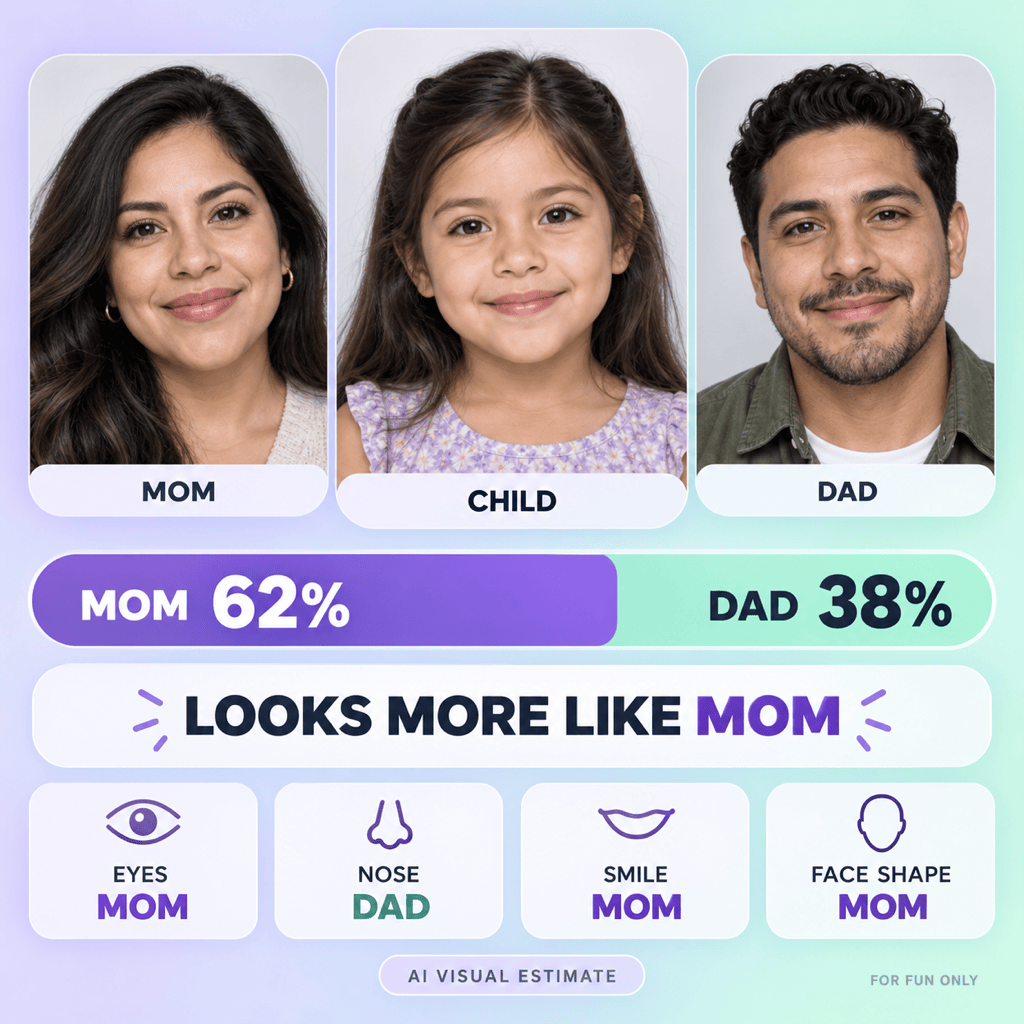
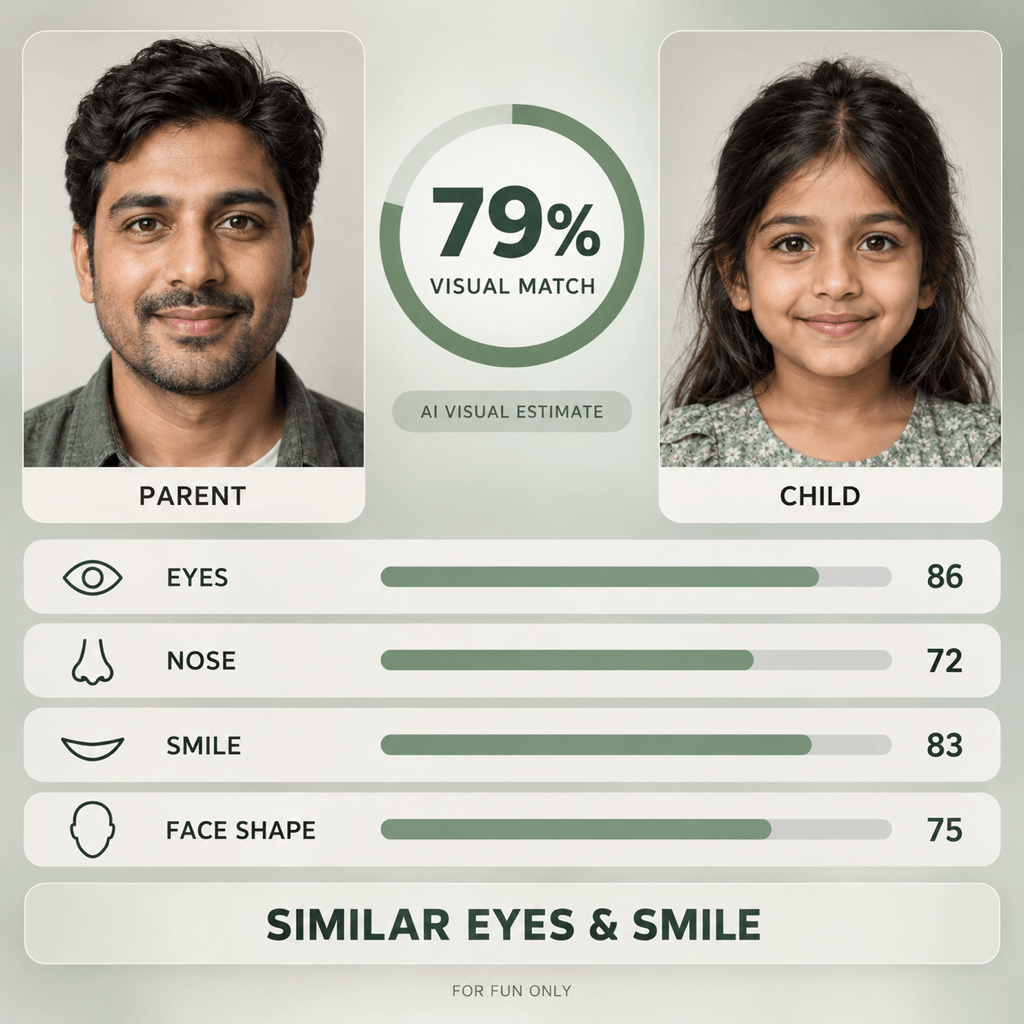
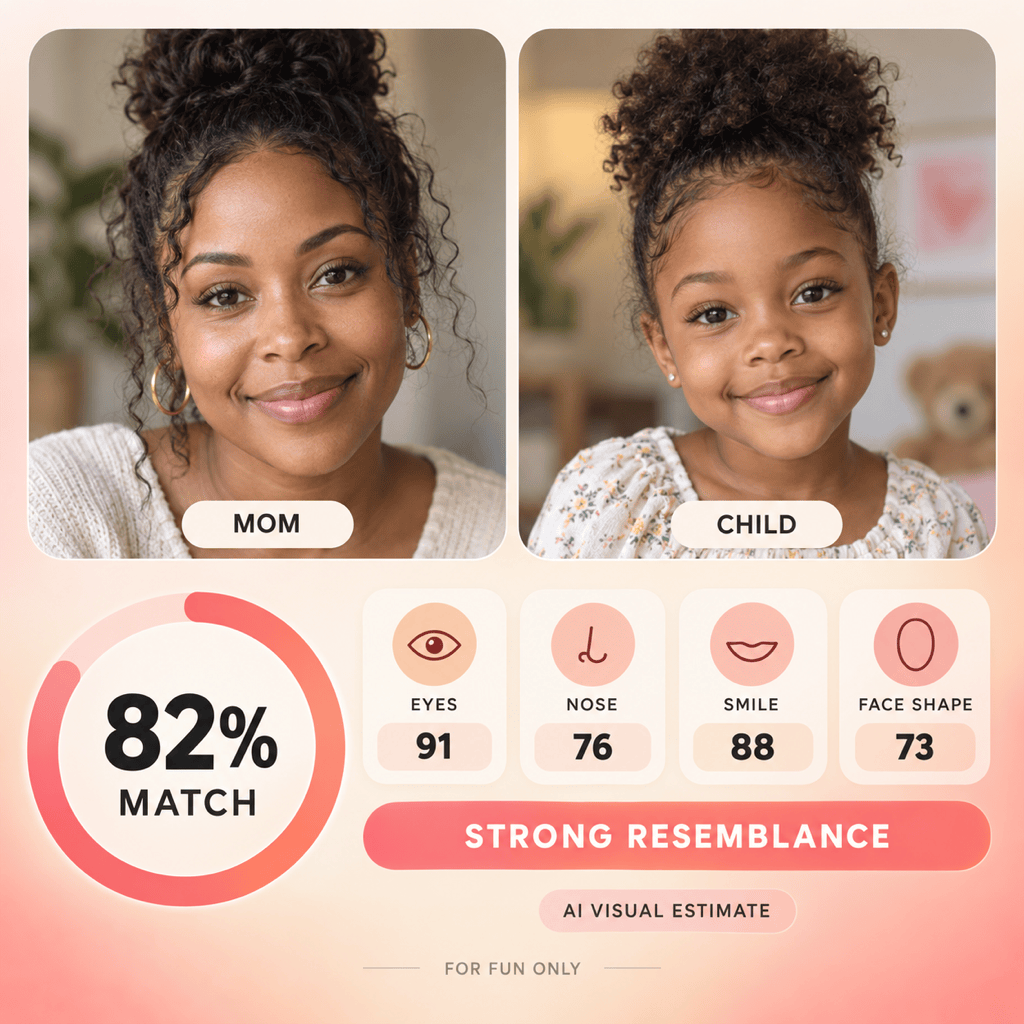
Free OnlineAI Parent-Child Similarity Test
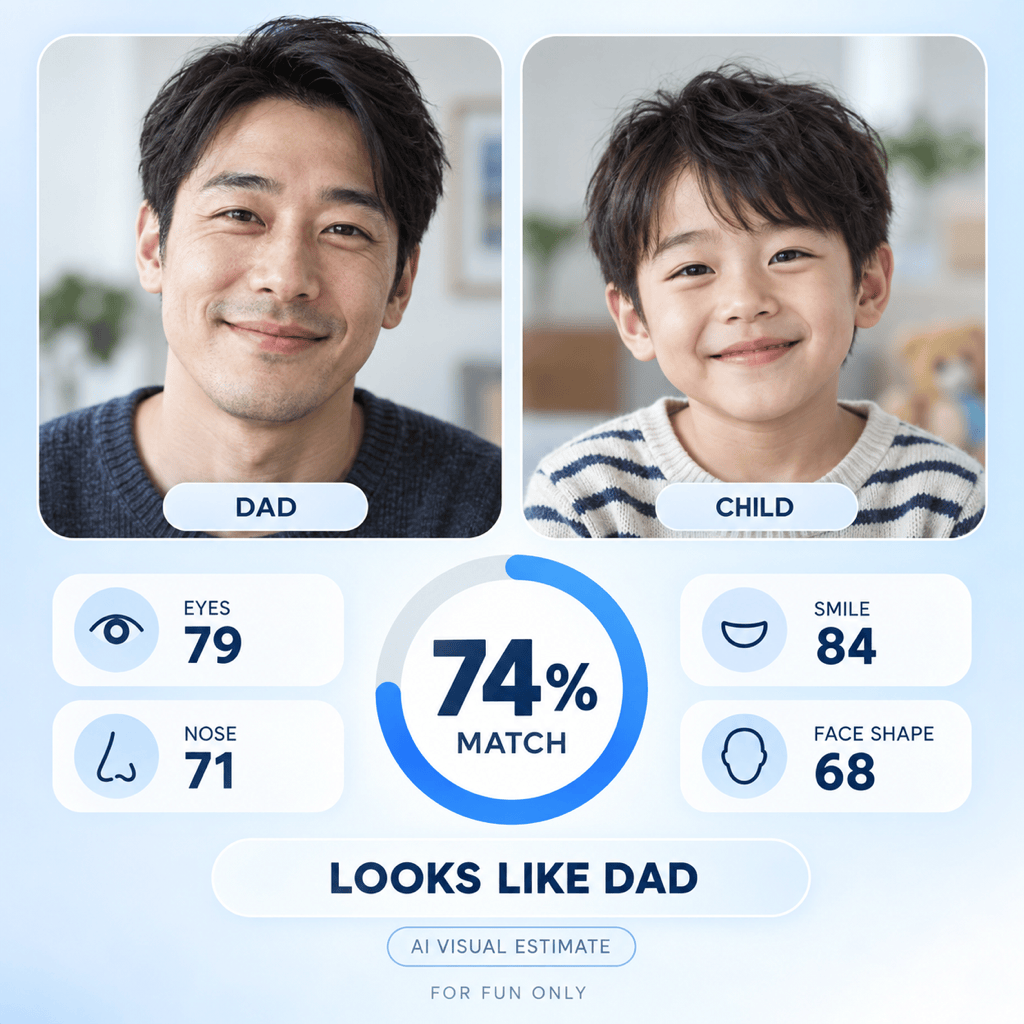
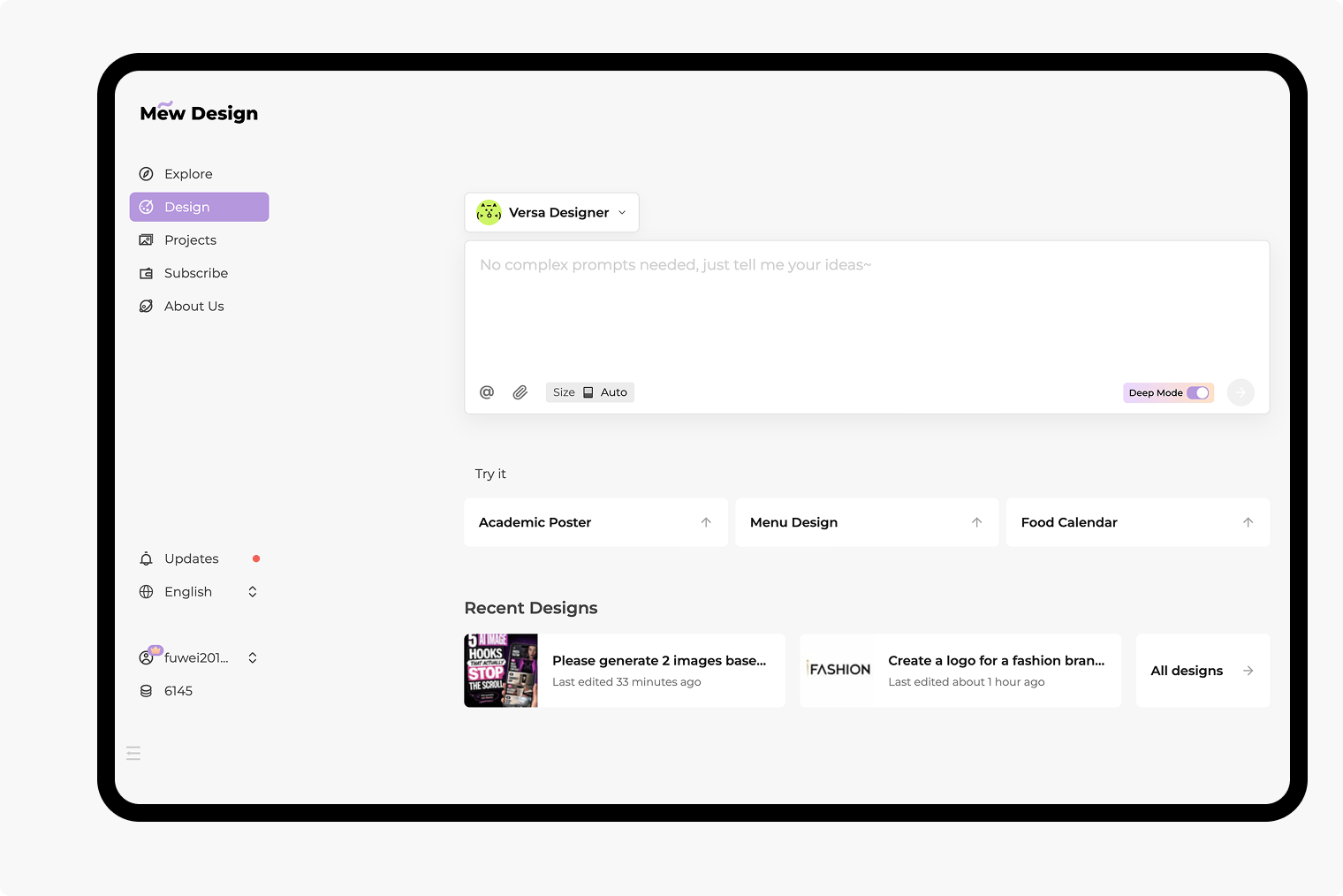
Mew Design - AI Design Agent helps you compare a child with Mom, Dad, or both across visible face shape, eyes, nose, mouth, and smile. Upload clear family portraits, request an AI-estimated similarity percentage and feature-by-feature breakdown, then refine the result into a shareable scorecard. For entertainment only—not a DNA or paternity test.

How to Compare Parent and Child Faces with AI

Use clear family portraits to create an entertainment-only parent-child similarity score, facial-feature breakdown, and shareable result card.
1

Choose Clear Front-Facing Photos

Use one portrait for the child and one for each parent you want to compare. Keep the full face visible, use even lighting and a neutral expression, and avoid filters, sunglasses, hats, or heavy shadows.
2

Upload Photos and Label Each Person

Upload the images and identify Mom, Child, and Dad in the prompt. Similar camera angles, head sizes, and recent photos make the visible parent-child face comparison easier to interpret.
3

Request Scores and a Feature Breakdown

Ask the AI to compare visible face shape, eyes and eyebrows, nose, mouth and smile, and jawline. Specify child-to-mom and child-to-dad estimated percentages, plus a short “looks more like” verdict.
4

Review, Refine, and Share

Treat every score as a playful visual estimate. Use Chat Edit to fix labels, percentages, crops, or layout, add an entertainment-only note, and export the finished scorecard as PNG or JPG.
How to upload parent and child photos and create an AI similarity scorecard

Why Use Mew Design for an AI Parent-Child Similarity Test

Compare One or Both Parents

Create a one-to-one parent-child similarity score or a Mom-versus-Dad result. Upload the people you want to compare and clearly assign each photo in the prompt.

Break Down Visible Facial Features

Go beyond one overall number by requesting separate observations for eyes, eyebrows, nose, mouth, smile, face shape, and jawline—the traits users expect from a family face match.

Answer “Who Does My Child Look Like?”

Turn the visual comparison into an easy-to-read Mom and Dad percentage split, a stronger-match verdict, and a short explanation of which visible traits drive the result.

Create an Editable Result Card

Ask for a square scorecard, vertical story, or print-friendly comparison with clear portrait labels, large percentages, feature rows, and a shareable visual hierarchy.

Refine the Result by Chat

Use Chat Edit to correct a swapped role, adjust a score or feature label, improve readability, or restyle the result. Models such as GPT Image 2 help create polished comparison graphics.

Keep the Result in the Right Context

Add “AI visual estimate” and “for entertainment only” to the design. The score compares visible appearance in the uploaded photos; it cannot prove identity, genetics, paternity, or another biological relationship.

How to Prompt an AI Parent-Child Face Comparison

Compare the child in Image 2 with Mom in Image 1 and Dad in Image 3. Evaluate visible face shape, eyes and eyebrows, nose, mouth and smile, and jawline. Create an editable square scorecard with separate child-to-mom and child-to-dad AI-estimated percentages that total 100%, a short trait-by-trait breakdown, and a ‘looks more like Mom/Dad’ summary. Keep every face recognizable and label the result ‘AI visual estimate — for entertainment only, not a DNA or paternity test.’
A strong AI parent-child similarity prompt names each person, asks for specific visible traits, defines the scoring format, and states that the result is an entertainment-only estimate.
  • Assign Photo Roles: Say exactly which upload is Mom, Child, and Dad. This prevents swapped portraits and makes the requested pairings unambiguous.
  • Control Photo Quality: Use front-facing, well-lit, minimally filtered portraits with the full face visible and roughly similar angles or expressions.
  • Name the Features: Request face shape, eyes and eyebrows, nose, mouth and smile, and jawline instead of asking only for a vague overall match.
  • Define the Result: Specify independent match scores or a Mom-versus-Dad split, a concise verdict, an editable card format, and a visible entertainment-only disclaimer.

AI Parent-Child Similarity Prompts for Scores and Feature Comparisons

Mom and Child Similarity Score: Compare Mom in Image 1 with the child in Image 2. Evaluate visible face shape, eyes, nose, smile, and jawline. Create a clean square card with one AI-estimated match percentage, four feature scores, and the note ‘For entertainment only.’

Dad and Child Face Match: Compare Dad in Image 1 with the child in Image 2 using clear frontal portraits. Show an AI-estimated overall resemblance score, the strongest shared facial features, and a concise result. Keep both faces recognizable and avoid DNA or identity claims.

Who Does the Child Look Like More?: Use my Mom, Child, and Dad photos to create a Mom-versus-Dad comparison. Show child-to-mom and child-to-dad percentages that total 100%, identify the stronger resemblance, and explain the result using eyes, nose, smile, and face shape.

Feature-by-Feature Parent-Child Comparison: Build an editable report card comparing the parent and child across eyes and eyebrows, nose, mouth and smile, face shape, and jawline. Include one overall visual-match estimate and a short note on the two most similar traits.

Same-Age Family Resemblance Test: Compare a parent’s childhood photo with a current photo of their child at a similar age. Account for photo quality and era differences, show an AI-estimated similarity score, and keep the analysis limited to visible facial appearance.

Shareable Mom-Dad-Child Scorecard: Create a vertical social story with Mom and Dad at the top and the child centered below. Add readable percentage bars, four facial-feature winners, a ‘looks more like’ verdict, and ‘AI visual estimate — for fun only.’
FAQs About AI Parent-Child Similarity Scores

It is a visual estimate based on the apparent facial features in the uploaded photos, such as face shape, eyes, nose, mouth, smile, and jawline. It is designed for fun and creative comparison, not scientific proof.
The result can change with lighting, angle, expression, age, crop, filters, and the model’s interpretation. Treat the percentage and feature breakdown as an entertainment-only estimate rather than a precise or repeatable biometric measurement.
Choose sharp, recent, front-facing portraits with the full face visible, even lighting, a neutral or similar expression, and minimal filters. Avoid sunglasses, hats, motion blur, extreme angles, and heavy shadows.
Yes. Upload one clear photo of Mom, Child, and Dad, label each image, and ask for either two independent similarity scores or a Mom-versus-Dad percentage split with a ‘looks more like’ verdict.
No. A face comparison cannot confirm identity, genetics, paternity, or any biological relationship. Use an accredited DNA test and qualified professional guidance when scientific or legal proof is required.
Facial appearance changes with pose, lens, lighting, expression, age, hairstyle, and image quality. Use comparable portraits and state the same feature list and score format when you want a more consistent creative result.
Yes. Ask for a square post, vertical story, or printable card, then use Chat Edit to refine portraits, labels, percentages, feature rows, colors, and disclaimer text before exporting as PNG or JPG.
Use only photos you are authorized to upload, avoid images that reveal unnecessary personal information, and review the service terms and privacy information before using family portraits.

Ready to Generate Designs With AI?

Get Started - 50 Free Credits
No credit card required
© 2025 - 2026 Mew Design, MAGOAI LTD.All rights reserved.